Foundation repair in Rockwall, TX
If you live in Rockwall, your house is probably on clay that moves. USDA soil maps show the area around the downtown square as Heiden clay. Much of north Rockwall is Houston Black clay, and the east side has a lot of Ferris-Heiden soil. All three are rated very high for shrink-swell, which means they swell in wet spells and pull back hard in dry ones. When that happens unevenly under a slab, you get the cracks and sticking doors that send people looking for help.
We connect Rockwall homeowners with one local foundation contractor. You call or fill out a short form, and one company calls you back. You won't get a pile of quotes calling you.
Call (972) XXX-XXXX Tell us what you're seeing
Calls may be recorded. We call you back first. We share your details with a contractor only after you say yes, and we tell you who it is.
A town named after something in the ground
Rockwall got its name from the ground. In 1851–52, settlers digging a well hit what looked like a buried stone wall. Geologists later showed it was a set of natural sandstone "clastic dikes": cracks in ancient marine clay that filled with sand and hardened into something that looks like laid masonry. The town was platted in 1854 and named for it, and the county took the name in 1873.
The same clays the rock wall formed in are still under today's neighborhoods, and they're why foundation work is a regular part of owning a home here.
What's under Rockwall homes
| Part of town (sample point) | Mapped soil (USDA) | Shrink-swell |
|---|---|---|
| Downtown / around the square | Heiden clay, 3–5% slopes | Very high (LEP ≈ 12%) |
| North Rockwall | Houston Black clay, 1–3% slopes | Very high (LEP ≈ 12%) |
| East Rockwall | Ferris-Heiden complex | Very high (LEP ≈ 12–13%) |
| Southwest, near the lakeshore | Altoga silty clay | High (LEP ≈ 7.5%) |
These are USDA map units at sample points. Your lot can differ, especially where builders brought in fill. LEP (linear extensibility) is the USDA's shrink-swell measure.
What that means in practice:
- Dry summers are when trouble shows. Houston Black clay can crack 0.5 to 4 inches wide and more than a foot deep when it dries out, and those cracks can stay open 90–150 days a year. Calls to foundation companies across North Texas pick up from July through October.
- Slopes and drainage matter. Heiden and Ferris soils sit on the rolling ground east and north of town. If water runs toward your foundation on one side and away on the other, the soil moves unevenly. Gutters, downspout extensions and grading are often part of the fix.
- Trees near the house pull moisture from one side of the slab in summer. If there's a big tree close to the house, mention it when you call.
Rockwall homes by age
Rockwall grew fast. Of the roughly 19,300 homes in the city, the Census Bureau estimates:
- About 1 in 3 were built in the 2000s and another 1 in 5 in the 2010s
- About 15% in the 1990s and 14% in the 1980s
- Only a small share are older than 1980, mostly near the original downtown
The median Rockwall home was built in 2003. A lot of houses are now 15–25 years old, well past any builder warranty, and have been through several drought summers.
The City of Rockwall's subdivision records show when each neighborhood was platted, and most were built in phases over many years:
- Newer neighborhoods: Breezy Hill (platted 2014–2020) and Stone Creek (2008–2020). Most homes here are on slabs, and repairs usually mean piers under the low side plus drainage work.
- 1990s–2010s neighborhoods: Caruth Lake (platted in phases from 1994 to 2015) and Highland Meadows (1996–2000). Homes in the early phases may be on their first foundation repair, or due to re-check an older one.
- Rockwall's older lake-area neighborhoods: Chandlers Landing (first platted in 1973) and The Shores (first platted in 1978). Many of these homes are 30 to 50 years old, so ask about earlier repairs and old pier warranties when you buy or sell.
- Older homes near the square may be pier-and-beam (look for crawlspace vents along the bottom of the exterior wall). Pier-and-beam repairs are a different job: shims, beams and supports rather than slab piers.
Signs to watch for in a Rockwall house
- Stair-step cracks in brick near corners, windows or the garage
- Interior doors that suddenly rub or won't latch
- Cracks at the corners of door frames and windows inside
- A gap opening where the wall meets the ceiling
- Floors that slope toward one side of the house
- Cracks in the garage slab that keep getting longer
What a foundation inspection involves
What foundation repair costs in Rockwall
We don't publish quotes, because every house is different. As a guide, published Dallas–Fort Worth cost guides put most residential foundation repairs between about $4,000 and $15,000:
- Typical slab pier job: about $5,000–$8,500 (often 8–12 piers)
- Minor crack repair: about $500–$2,000
- Major repairs: $12,000–$25,000 or more
- Add-ons: root barriers (about $1,000–$4,000) and drainage correction (about $2,000–$8,000) are common in clay-soil areas
Those are general DFW ranges, not Rockwall-specific prices. Full cost guide.
Permits and engineers in Rockwall
The City of Rockwall's published list of residential projects that need a permit doesn't name foundation repair. The city's building code does require any new foundation or foundation addition to be designed and sealed by a Texas-registered engineer. Rules change, so for your exact project confirm with City of Rockwall Building Inspections at (972) 771-7709. A good contractor will know the answer.
If you're buying a house in Rockwall and the inspection flags the foundation, use your option period well. An independent structural engineer's report gives you something neutral to negotiate with.
How it works
- Call or send the form. Tell us your street, what you're seeing and roughly when the house was built.
- We call you back first. We'll hear what's going on. If you want a contractor to look at it, we'll name the one independent local contractor we'd refer you to in Rockwall, and share your details only after you say yes. Your details aren't sold to a list.
- They inspect and explain. Ask to see the floor-elevation readings and what they think is causing the movement.
You don't pay us. We may be paid by the contractor for the referral. How this works.
Rockwall foundation questions
Is foundation movement normal in Rockwall?
Some movement is normal on clay. Houston Black, Heiden and Ferris soils all swell and shrink with moisture. What's not normal is movement that keeps getting worse: cracks that widen, doors that stop closing, floors you can feel sloping.
Does homeowners insurance cover it?
Usually not for soil movement. The Texas Department of Insurance lists earth movement among the things most policies don't cover. Damage from a sudden plumbing leak may be covered, and some insurers offer a foundation or slab endorsement. Check your policy.
I live near the lake. Is that worse?
Not automatically. Lakeshore lots tend to be hillier, so drainage and runoff matter more. Mapped soils near parts of the shore (Altoga silty clay) are rated a step lower for shrink-swell than the heavy clays inland. Your lot is what counts.
Is Two Lakes a contractor?
No. We're a referral service. The contractor does the inspection, the quote and the work.
Do you cover Heath, Fate or Royse City?
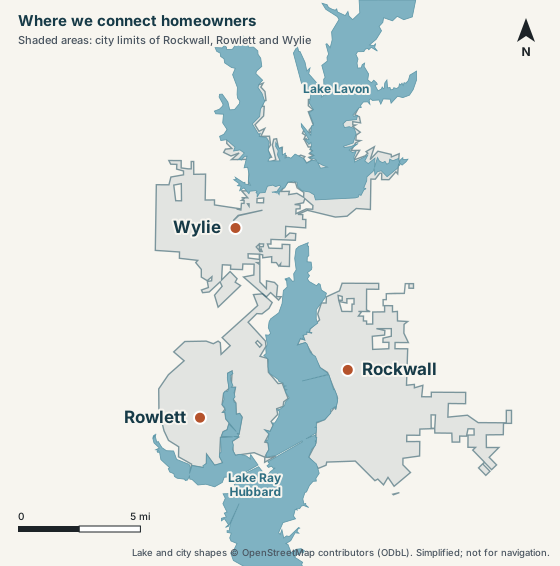
This site is written for Rockwall, Rowlett and Wylie. If you're just outside them, call anyway. When we call you back, we'll tell you honestly whether we can refer you to a contractor who works on your street, and we won't share your details unless you say yes.
Also serving nearby
Foundation repair in Rowlett · Foundation repair in Wylie