House leveling: slab and pier-and-beam
"Leveling" means lifting the low parts of a house back toward level and supporting them so they stay there. How that's done depends on what your house sits on.
Call (972) XXX-XXXX Tell us what you're seeing
Which kind of foundation do you have?
- Slab-on-grade: the floor sits right on a concrete slab. No crawlspace vents along the bottom of the outside walls. Most homes built here since the 1980s are slabs, and many newer ones are post-tensioned (steel cables run through the concrete).
- Pier-and-beam: the floor sits on wood beams over a crawlspace, with small vents or an access door along the bottom of the outside wall. More common in older homes.
Not sure? Look for vents along the base of the outside walls, or check your inspection report.
Leveling a slab
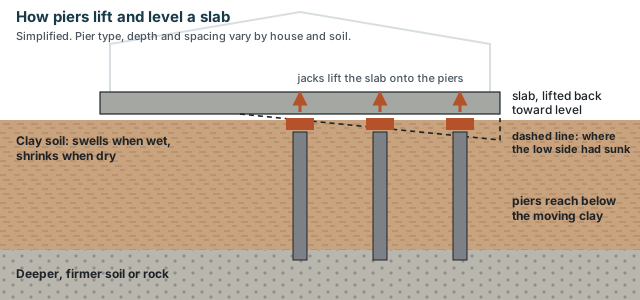
Slab repairs usually mean installing piers under the low side of the house, then lifting the slab with jacks and setting it on those piers. Common types:
- Pressed concrete piers: stacked concrete cylinders pushed into the ground until they stop.
- Steel piers: steel pipe driven deeper, often toward firmer soil or rock.
- Drilled concrete piers: holes drilled and filled with reinforced concrete, sometimes with a bell at the bottom.
Each has trade-offs in depth, cost and warranty. Ask the contractor why they picked that type for your soil, and how deep they expect to go. On a post-tension slab, also ask how they'll avoid the cables.
Leveling a pier-and-beam house
Pier-and-beam repairs are a different job. They're usually about adding or resetting shims, replacing rotted or sagging beams and joists, adding support piers, and dealing with crawlspace moisture and ventilation. Floors that feel springy or bouncy are often a beam or joist problem, not a foundation failure. (This is also what people searching for "wood foundation repair" usually need.)
Leveling isn't "perfectly flat"
Few houses are dead level, even new ones. The goal is to get the house back within a reasonable range and stop the movement. Lifting too hard can crack things that weren't cracked before. A good contractor will tell you up front what they expect to recover and what new cracks might appear.
The part people skip: water
On Blackland Prairie clay, moisture is what moves the house. If water pools against one side or a big tree dries out one corner, the soil keeps moving after the piers go in. Gutters, downspout extensions, grading, and sometimes a root barrier are often part of the fix. A plumbing leak under the slab can do the same thing, so it's worth ruling out.
Before you sign
- Get the pier count and a pier map in writing.
- Get the warranty in writing: what it covers, how long, whether it transfers when you sell.
- Ask who handles the permit, if the city needs one.
- Ask about drainage work and whether it's included.
- For large jobs, consider an independent engineer's opinion.
See what leveling and pier work typically cost in DFW.
Where we connect homeowners
- Foundation repair in Rockwall: mostly 2000s homes on Heiden and Houston Black clay
- Foundation repair in Rowlett: the oldest housing of the three, on the Lake Ray Hubbard shore
- Foundation repair in Wylie: newer homes, many now past builder warranty
Want a ballpark first? Read what foundation repair costs, or tell us what you're seeing.